The Hidden Cost of Knowledge Silos in Your Dev Team


I have seen many times a thought on LinkedIn: “Make yourself irreplaceable at work.” It sounds like career wisdom. Become so essential that the company can’t function without you. But here’s what I’ve learned after years as a software developer and team captain: being irreplaceable is actually holding you back.
This article is part of the Knowledge Silos series:
- Part 1: The Hidden Cost of Knowledge Silos (you are here)
- Part 2: The 4-Step System to Eliminate Knowledge Silos (coming soon)
- Part 3: Why Being Replaceable Is Your Best Career Move (coming soon)
Last year, I took my first three-week vacation in my career. As a Team Captain I was a bit worried how things will go. You know what happened? The team thrived. They followed our established rituals, delivered value to customers, and handled everything smoothly. No emergencies, no urgent calls, no disasters.
This wasn’t an accident. It was the result of specific actions we took to build team resilience.
Being replaceable isn’t about being redundant. It’s about building resilient systems and empowering teams.
The Hidden Cost of Being “Irreplaceable”
When you’re the single person who knows how something works, you might feel secure, important, irreplaceable. But consider the real consequences:
- You can’t take a real vacation. Your phone buzzes with “quick questions” even on the beach.
- You become a bottleneck. Projects stall waiting for your input.
- Your growth stagnates. You’re too valuable in your current role to be promoted.
- Burnout becomes inevitable. You’re the single point of failure, and that weight never lifts.
I’ve seen brilliant developers trapped in the same role for years because their managers couldn’t afford to move them. They became victims of their own “irreplaceability.”
What is a Knowledge Silo?
A knowledge silo forms when critical information stays trapped within one person or one group, with no transfer to the rest of the team.
It’s not always one lone expert. It can be an entire subgroup — three developers who always pick tasks from the same module because that’s what they know, while the other five never touch it. It feels efficient. It’s comfortable. And it quietly turns into a fragile dependency nobody notices until someone goes on vacation.
That’s the thing about silos: they don’t form from bad intentions. They form from convenience.
Sound familiar? Maybe it’s you. Maybe it’s someone on your team. Either way, it’s a risk.
The Bus Factor: More Than Just a Metric
In software development, we talk about the “bus factor.” How many team members could be hit by a bus before a project fails? (That’s dark. Let’s say they missed the bus.)
If your team’s bus factor is 1 (you?), that’s a disaster waiting to happen.
Do you know, that in big corporations and governments, there are specific rules that people crucial for operations cannot travel together in the same bus, plane, or train? That’s how serious single points of failure are. Imagine this: half of your team is late for the flight to a conference — Congrats! You accidentally mitigated a risk.
How to Measure Your Team’s Bus Factor
You can’t fix what you don’t measure. Here’s a practical assessment framework to evaluate your team’s knowledge distribution.
Ask these questions about your team:
Critical Operations
- Who’s the only person who can deploy to production?
- Who can debug production issues?
- Who holds tribal knowledge about the legacy system?
Day-to-Day Work
- Which components have single owners?
- Who can onboard new hires?
- Who reviews architecture decisions?
- Who has access to critical accounts and services?
What Happens During Absence
- What happens when key people take vacation?
- How many people can handle emergency decisions?
- Who covers for the “irreplaceable” expert?
Scoring Your Bus Factor
For each critical area, count how many people can handle it independently:
- Bus Factor 1 = Critical Risk. Entire project depends on one person. This is a red alert.
- Bus Factor 2 = High Risk. Two people means less fragility, but still vulnerable. One absence creates a single point of failure.
- Bus Factor 3 = Stable. Knowledge shared across three people. The team can handle vacations and unexpected absences.
Anything above 3 is a resilent team that mastered knowledge sharing.
Self-Assessment Exercise
The bus factor is not a single score for your whole team. It’s calculated per area. Each critical area has its own number, and your weakest area is your real risk.
Here’s how to do it in three steps:
-
List your five most critical areas. Think: deployment, architecture decisions, customer escalations, legacy system knowledge, on-call incident response. Pick the ones where a gap would actually hurt.
-
For each area, write down every person who can handle it independently. Without asking for help.
-
Count the names. That count is the bus factor for that area.
I built a ready-to-fill Team Bus Factor Calculator PDF template for this exercise — you can grab it at the end of the article.
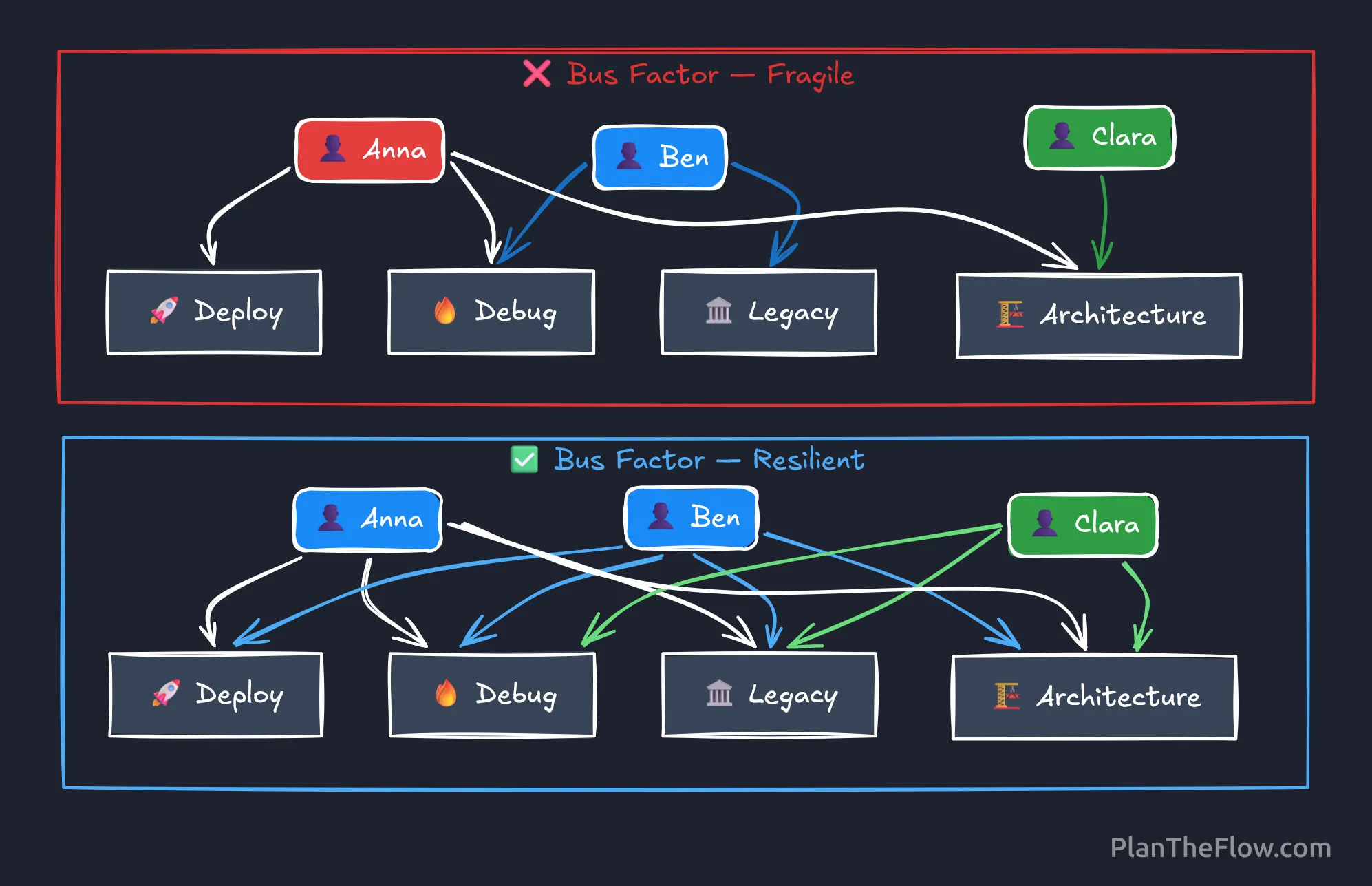
Here’s what a filled table might look like:
| Area | Who can handle it | Bus Factor |
|---|---|---|
| Deploy to production | Anna | 1 🚨 |
| Debug production issues | Anna, Ben | 2 ⚠️ |
| Legacy system knowledge | Ben | 1 🚨 |
| Onboard new hires | Anna, Ben, Clara | 3 ✅ |
| Architecture decisions | Anna, Clara | 2 ⚠️ |
In this example, the team’s real bus factor is 1: because two critical areas depend on a single person. Even though onboarding looks healthy, one bus (or one resignation, sick leave, longer vacation) breaks the whole system. Notice Anna. She’s carrying half the team. She also probably hasn’t taken a vacation since she accidentally became important.
If you see one name listed across multiple areas, or just one name in any row, that’s your red flag. You don’t sum the scores. You look for the lowest number. A bus factor of 1 anywhere is a single point of failure, no matter how healthy the rest of the table looks.
The goal isn’t to replace experts. It’s to ensure expertise is shared, documented, and distributed so the team stays resilient even when someone is unavailable.
What This Means for You
If your bus factor score is below 3 in critical areas, you have an on organizational risk. It a good rule of thumb to have at least 2 people responsible for each piece of the project.
But here’s the good news: this isn’t permanent. Knowledge silos can be broken down systematically, without grinding productivity to a halt.
Now you’ve identified your single points of failure. The question is: how do you fix it without sacrificing velocity? In Part 2, I’ll show you the exact 4-step system my team used to increase our bus factor from 1 to 4 while maintaining velocity.
Don’t miss Part 2 — subscribe below and I’ll send it straight to your inbox when it’s out.
Download the Team Bus Factor Calculator – A free PDF template to map your team’s knowledge distribution and identify critical risks. Download the free PDF template →
Stay in the Flow – Explore More Stories
How to optimize daily standups for software developers: transform boring reports to collaborative teamwork. My team's journey to boost productivity & engagement

This step-by-step tutorial guides you in creating your own cards, perfect for card-based project, like designing a board game or using Agile Poker Cards PDF.

A 3-step system for managing Slack interruptions without missing important messages. Stop context switching and protect your deep work time as a developer.